humandesign

Thursday, December 09, 2004

The 21st Century Living Room

Would you rather enjoy your digital photos, videos and music on your PC, or on the big screen of the television set you already have? Imagine you could share your digital media with your family and friends from the comfort and convenience of the couch in the living room.

To fill such a need, retailers are selling new products which are sometimes called "digital media receivers" or "media hubs".

One such product, the new MSN TV 2 Internet & Media Player from Microsoft, allows users to quickly and easily connect their PC to the TV through a home network to play digital content, as well as to play video or audio live from the Internet. Additionally, they can surf the Web, send and receive e-mail and chat with friends via the television.

I quote from Sam Klepper, general manager of Microsoft's MSN TV division.

"Everything points to the fact that people want the option of taking Internet entertainment and stored personal photos, music and videos out of the confines of their home offices and into the comfort of their living rooms."

The range of prices for these devices is equally broad: from as low as $200 plus a subscription fee for MSN TV and up to US$1600 for a sophisticated PC.

"Consumers don't have to huddle in front of a computer screen to see or listen to digital content anymore," said Klepper. "Digital media receivers make it easy for them to bring the compelling new entertainment available on the Internet as well as personal photos and digital home movie into the comfort of their living room, the traditional hub for enjoying entertainment. It's an idea whose time has come."

Further information on the MSN TV 2 Internet and Media Player can be found at http://www.msntv.com/

Sunday, December 05, 2004

Better than blackberry

Better than blackberry

According to some in the wireless industry, web access for road warriors and other mobile users is as easy as pulling out a Blackberry handheld device, wireless PDA or Internet-enabled cell phone.

Why not ask the actual users of mobile Internet technology, however, and you'll often get a far different story.

Tiny display screens. Frustratingly small keyboards. Clipped or squashed web pages. Unreliable coverage. And download times rivaling the last Ice Age.

A solution to the problems, DataWind Corporation has recently showcase their new product, PocketSurfer Web Viewer, the first cell phone accessory that provides a desktop-quality web experience in a device small enough for breast pocket or purse.

I quote from Suneet S. Tuli, chief executive officer of DataWind.

"All-in-one cellular Internet products try to do too many things, and wind up doing none of them well. The PocketSurfer lets cell phone users access the technology they need, when they need it, with complete flexibility and convenience. And it does this at a lower overall cost than a Blackberry or Handspring Treo."

Let take a peek at what they have to offer.

It is affordable, at the price of $199.00 USD .

With just 6" x 3" and less than 9/16" thick, the PocketSurfer is small enough to carry anywhere, yet big enough to solve two of the most annoying drawbacks of personal mobile web devices-undersized keyboards and screens.

They clain that once they're online, users are overwhelmed by the page downloads which take just 5 to 7 seconds on average. This speed is 10 to 30 times faster than with typical WAP enabled cell phones and PDAs. Furthermore, page integrity is maintained. Users gets to see web sites as they're meant to be seen, without clipping or reformatting.

The QWERTY keyboard also makes sending email as easy as with a PC.

The device includes a mouse pointer and page navigation controls.

The lithium ion battery lasts four to six hours which is longer than most cell phones.

This pocketsurfer is indeed some gadget to look forward to, as it sounds to good to be true. I wish i could get one for christmas.

Sunday, November 28, 2004

Phone hacking is bad, how can we prevent it ?

In relations to Thursday, November 25, 2004, the post on "Trojan on cell phones".

I agree that phone should adapt to insecure medium but that will not solve this problem entirely. Let's us take a history trip back to the past.

Cell phones have never been exactly known as secure devices. With analog phones, curious "hobbyists" can pick up your conversations using the type of radio frequency scanner that you buy at Radio-Specialist shops to listen to police and emergency services bands. Digital and PCS transmissions are more secure, but can still be intercepted and decoded by someone with the right equipment. I am sure all of you know that your cell phone transmits every few seconds when it's turned on, even if you aren't talking on it.

How can mobile phone technology be made more secure? Many phones allow the owner to "lock" them so that no calls, or no long distance calls, can be made. A password or PIN must be entered to unlock the phone. Last year, Casio developed a tiny fingerprint scanner for cell phones that could be used to require biometric identification to use the phone, but it doesn't seem to have caught on. Similarly, a German company announced a "cryptophone" that promised high level protection against eavesdroppers, but with its $4,000 price tag (USD), it wasn't exactly marketed toward the average cell phone user.

Here are some questions we ponder:

What do you think about this now? Are you worried about the security of your mobile phone, or do you think that we should get better security from the phone company since we paid so much?

Similarly, if the price were right, would you prefer phones that require strong authentication (such as a fingerprint scan or a "smart card"), password/PIN protection, or strong encryption technology?

Now, with phone hackers on the lose, there might even be a possibility that cell phones will eventually become vulnerable to attacks by Internet-connected computers ? Considering Internet-connected phone or IP phones are getting more and more accepted by consumers.

Sunday, November 21, 2004

Play Pac-man in the real world ?


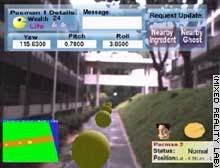
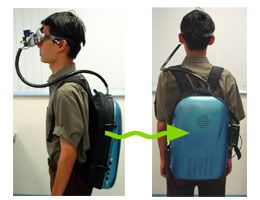
Yes, just imagine, players put on some computerised suits and special goggles which allow them to see virtual elements present in the Pac-Man game world such as edible balls for points as well as other players who will appear either as other Pac-Men or Ghosts. Most interestingly, the game's backdrop is set in our every own world.


One day, we might be playing Pac-Man in big shopping malls or right in the heart of our main campus.

Furthermore, if this game is developed on mobile devices such as the mobile phones, imagine what kind of effect it will take on gamers in the next decade.

See more from CNN

Sunday, November 14, 2004

3D games

PC games have come a long way to its present state. Ever since 3D games became one of the most played games, I have been always excited to try all of them. Well, as you know, there are two standards in 3D graphic rendering, Direct 3D and OpenGL.

Direct 3D vs OpenGl

From my research, I realised that these standards can be selected in different situation to give better 3D processing. These situation are based on ease of use, speed, extensions and portability. Since OpenGL seem to be a better option in many cases, most game developers would still allow you to choose which standard to use.

For me, I quite like how the way 3D games are installed now. Most of them can detect your system's configuration and give you the best suggestion which standard to use. This transparency allows the user to quickly install the game and start playing the game which what we buy the game for right? It's not a good idea to let the gamer to ponder on which standards to use and he/she does not even know whether the game is compatible to the PC's configurations.

Sunday, November 07, 2004

Have you ever ignored the fire alarm ?

Yes, obviously you can't. The fire alarm is the primary warning signal in any detected occurrence of a fire. In my opinion, we should never take any chances in these emergencies.

But that has changed ever since my stay in one of the school hall of residences. Each week, on the average, the alarm sounded about 1-4 times on weekdays and about 1-3 on weekends. Till now, all of these warnings turned out to be just false alarms. Due to this circumstance, my confidence in the fire alarm warning system was greatly dampen. Nowadays, instead of rushing out of the building, my flatmates and I preferred to endure the annoying alarm and continue to stay in our rooms.

Seeing this as an opportunity for HCI blogging, i interviewed my flatmates and friends from other halls. The majority would just ignore it. This is totally insane !

This encounter made me realised that if we have to design some warning or error reporting system/programs, we do need to consider the priorties of reporting the warning/errors to the user/audience or it would be just plain annoying.

One examples would be Microsoft's Internet browser, the Internet explorer which would pop a dialog box asking whether if you want to debug the the error found ? These is definitely not required and totally useless to the user. Why would you ask the novice user to debug the errors? My suggestion would be to hide these error messages from the user but instead display it to the developers only.

As for the fire alarm problem, maybe they should just install water sprinklers that will activate in events of a detected fire in that particular room. This will definitely discourage pranksters and irresponsible hall mates. Of course, then it will be even more exciting to flood your flatmate's room !

Thursday, October 07, 2004

Which came first ? Chicken or the Egg

I am an international student and I chose to attend the freshers' week programme which had organized many induction programmes for a 'newbie' like me. For that week, it will cost me £140 and it begins two weeks before term starts.

During that week, we are supposed to register with the university, electronically. With a temporary password, I started with my registration. At the last stage of the online application, I am instructed to print a copy of the registration certificate and I am also asked to use my Student ID card to print it.

The problem is, I have to print out the registration certificate in order to exchange for my Student ID card. I am sure anyone who encounters this felt really ridiculous. Anyway, I believe that the administration found out about this problem and decided to let us print out the certificates without our ID cards.

This registration procedure designed by the school's administration could have been better if they put in some thoughts and considerations. I hope they will not repeat this mistake again.